Texas Sports Academy: The New “2-Hour School + 4-Hour Training” Model That Could Change Youth Sports in Texas
Texas youth sports are already intense.
Between private hitting lessons, strength training, speed work, weekend tournaments, recruiting videos, showcases, homework, and the daily carpool grind, serious student-athletes are living schedules that look more like college athletes than kids.
That is exactly the pain point Texas Sports Academy is trying to solve.
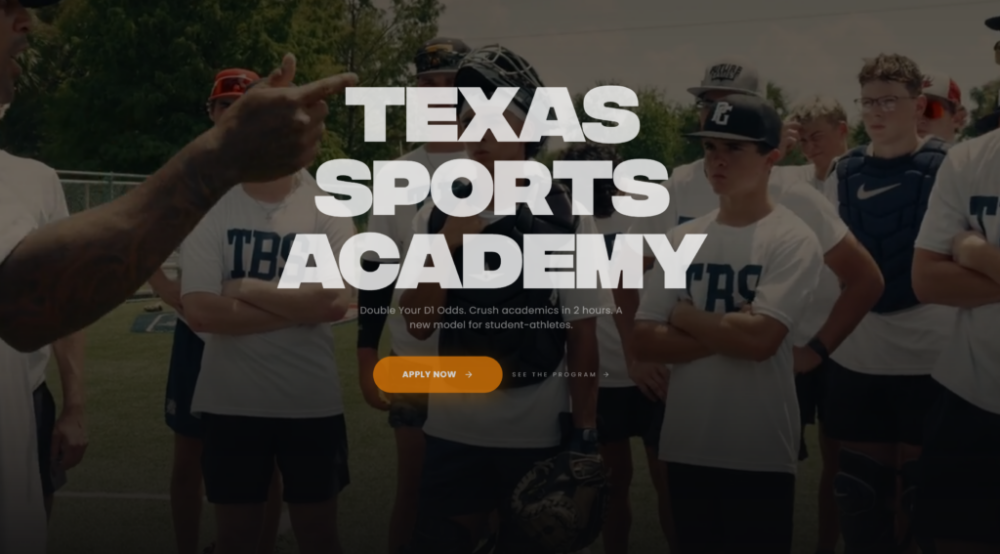
The pitch is simple and bold: finish academics in a concentrated morning block, then spend the afternoon training like an athlete. Texas Sports Academy describes itself as the sports academy of Alpha School, built around accelerated academics, AI-powered personalized learning, mastery-based progression, elite athletic coaching, and life-skills development. The program says students complete core academics in roughly two focused hours, then use the rest of the day for sports training and personal development.
For baseball parents in North Texas, this is the kind of model that immediately grabs attention.
Because let’s be honest: select baseball families are already rearranging life around development. The question is no longer whether families are willing to invest. They already are. The real question is whether a school model built around the athlete actually makes sense.
What Is Texas Sports Academy?
Texas Sports Academy is positioning itself as a private sports-focused academic model for serious student-athletes. The idea is to compress traditional academics into a shorter, more personalized learning window and create more room in the day for athletic training, recovery, life skills, and mentorship.
According to the school’s public materials, the model includes:
AI-powered personalized academics
Mastery-based progression
Two-hour academic blocks
Afternoon athletic training
Life-skills development
Coaching from former professional athletes
Multiple Texas locations and online options
Texas Sports Academy’s own site lists Carrollton, Houston, Plano, and other location-related pages, while broader Alpha School pages also point to Texas expansion and AI-powered private school models.
The core message is not subtle: traditional school takes too long, athletes need more time to train, and technology can make academic learning more efficient.
For the right family, that is a powerful pitch.
Why This Hits So Hard for Select Baseball Parents
Select baseball families already understand the time problem.
A serious player may have team practice twice a week, private hitting once a week, arm care, speed training, tournaments, lessons, recovery, and homework. Add school, commute time, siblings, and normal family life, and the calendar gets ridiculous fast.
That is why a model like Texas Sports Academy will appeal to a specific type of parent: the parent who believes their kid is not just “playing baseball,” but actively pursuing a long-term athletic path.
For baseball families, the benefits are obvious on paper:
More development time
Less rushed training after school
Earlier strength and mobility work
More time for recovery
Built-in mentorship
Potentially less academic busywork
A schedule that mirrors an athlete’s lifestyle
In theory, a player could finish academics before lunch, train in the afternoon, recover by dinner, and still have a more balanced evening than the traditional school-plus-late-practice grind.
That is a major shift.
The Big Claim: “Double Your D1 Odds”
This is where parents need to slow down.
“Double your D1 odds” is a great headline. It is also the kind of claim that deserves scrutiny.
There is no question that more structured training, better coaching, better recovery, and more time-on-task can improve a player’s development. But college baseball recruiting is brutally competitive. Division I roster spots are limited, and baseball is one of the hardest sports to project because puberty, injuries, velocity jumps, defensive position changes, strength gains, and late bloomers all matter.
A school can create a better development environment. It cannot guarantee a recruiting outcome.
So parents should hear the pitch this way:
Texas Sports Academy may offer a schedule and environment designed to support serious athletes.
It should not be treated as a guaranteed pathway to Division I baseball.
That distinction matters.
The Academic Model: Exciting, But Worth Investigating
The academic side is the most innovative part of the model — and probably the part parents should investigate most carefully.
Texas Sports Academy and Alpha School promote a “2 Hour Learning” model using AI, adaptive apps, personalized pacing, and mastery-based progression. Alpha School describes the approach as using adaptive technology to provide personalized learning and accelerate mastery of core subjects.
That sounds fantastic for students who are self-motivated, independent, competitive, and comfortable working through digital learning platforms.
But every child learns differently.
Some kids thrive with independence. Others need direct instruction, teacher relationships, discussion, structure, repetition, and hands-on explanation. Some athletes are internally driven. Others may need more support than a highly accelerated model provides.
There has also been public scrutiny around Alpha School’s broader AI-powered school model. Recent reporting has raised questions about regulation, supervision, student pressure, and whether certain campuses are legally categorized as schools or homeschool support centers depending on the state and location.
That does not mean the model is bad. It means parents should do real diligence.
Before enrolling, ask:
Is this campus legally recognized as a school or structured as a homeschool support center?
Who is responsible for academic oversight?
Are certified teachers involved?
What curriculum is used?
How is progress measured?
What happens if a student falls behind?
How much screen time is involved?
How are learning differences supported?
How does the transcript work for high school students?
How does this impact NCAA eligibility?
That last one is especially important for baseball families.
The NCAA Eligibility Question
For any athlete with college ambitions, academics are not just about learning. They are also about eligibility.
Parents of older athletes should verify whether courses, transcripts, grading, and academic records align with NCAA eligibility requirements. Do not assume a sports academy model automatically checks every box.
Ask the academy directly for:
NCAA course approval information
Transcript examples
Graduation pathway details
Accreditation status
College counseling support
Examples of student-athletes who have moved into college programs
How credits transfer if a family leaves the program
For younger athletes, this may feel far away. But for 8th grade and up, it matters fast.
Why This Model Could Work
The traditional school schedule was not designed around elite youth athletics.
A kid sitting in a classroom for six or seven hours, then trying to train seriously at night, then doing homework after dinner, then waking up early to do it again is not exactly peak performance science.
Texas Sports Academy is attacking that problem directly.
The upside is real:
Athletes get more focused development time.
Families may get evenings back.
Students may move faster academically if the model fits them.
Training can be periodized better.
Life skills like communication, leadership, content creation, financial literacy, and sports psychology can be built into the day.
Athletes may learn how to operate with more independence and accountability.
That last piece is underrated. The best athletes are not just talented. They know how to manage time, handle failure, communicate, recover, prepare, and lead.
If Texas Sports Academy truly develops those skills, that could be a major differentiator.
Why Parents Should Be Cautious
The risk is that parents fall in love with the dream before understanding the details.
Every parent wants to believe their kid just needs the right environment. And sometimes that is true. A better environment can unlock a child.
But youth sports also has a long history of selling hope.
The academy model is exciting, but parents should be careful about anything that sounds too clean:
Two hours of academics.
Four hours of training.
Pro-level coaching.
Better odds.
More time.
More confidence.
Better future.
That is powerful messaging. It may also create unrealistic expectations if parents do not ask hard questions.
A sports academy should be evaluated like any major family investment: academics, athletics, culture, cost, safety, outcomes, student fit, and long-term flexibility.
Questions Baseball Parents Should Ask Before Applying
Before enrolling your athlete, ask the program these questions directly:
1. Who is coaching baseball specifically?
Former pro athletes are great, but baseball development is position-specific. Ask who handles hitting, pitching, catching, throwing mechanics, arm care, strength, mobility, and recruiting guidance.
2. What does a weekly baseball development plan look like?
You want to see more than “training.” Ask about measurable development: exit velocity, throwing velocity, sprint times, mobility, bat speed, pitch design, defensive reps, recovery, and workload management.
3. How do they protect arms?
If your child pitches or throws often, this is non-negotiable. Ask how they track throwing volume, tournament workload, bullpens, velocity training, and recovery.
4. How are academics monitored?
Ask what happens when a student struggles. AI tools are useful, but kids still need humans who can intervene well.
5. What does the school day actually feel like?
Visit during a real school day. Watch the academic block. Watch the training block. Talk to current parents if possible.
6. What is the cost, and what is included?
Private academy models can be expensive. Clarify tuition, equipment, uniforms, travel, tournament fees, lessons, testing, and add-ons.
7. What happens if it is not a fit?
Ask how credits transfer and what the exit process looks like.

Is Texas Sports Academy Good for Every Baseball Player?
No.
And that is not a criticism.
This model is probably not for the casual player who simply enjoys baseball and wants a normal school experience. It may also not be ideal for a kid who needs a traditional teacher-led classroom, lots of peer variety, or a slower academic pace.
But for a serious, self-motivated athlete with a family already committed to development, it could be a very interesting option.
The best fit is probably a student-athlete who:
Loves training
Handles structure well
Can work independently
Has strong family support
Is comfortable with technology
Has clear athletic goals
Still values academics
Needs more time back in the day
The worst fit is probably a student-athlete whose parents want the academy to create motivation that is not already there.
That is a key distinction.
A sports academy can amplify drive. It usually cannot manufacture it from scratch.
The Bigger Trend: Youth Sports Is Becoming More Professionalized
Texas Sports Academy is part of a much bigger shift.
Youth sports is becoming more specialized, more expensive, more data-driven, and more professionalized. Baseball families already see it with private facilities, national teams, recruiting platforms, velocity programs, arm-care systems, tournament circuits, and social media exposure.
Now education is entering the same conversation.
The old model was: go to school, then play sports.
The emerging model is: build the school day around the athlete.
That is a massive change.
Whether you love it or hate it, this kind of program is probably not going away. In fact, with AI-based learning, private school expansion, education savings accounts, and the continued intensity of youth sports, we should expect more academies like this to appear across Texas. Community Impact reported that Alpha School planned to expand Texas Sports Academy campuses statewide, combining sport-specific athletic training with AI-driven academics.
For North Texas baseball parents, this is worth watching closely.
Final Take: Interesting, Innovative, and Worth a Hard Look
Texas Sports Academy is selling a compelling vision: fewer hours in traditional academics, more time for athletic development, and a school day designed around serious student-athletes.
That is going to resonate with a lot of baseball families.
But parents should approach it with both excitement and discipline.
The opportunity is real. The questions are real too.
Do not just ask, “Can this help my kid get better at baseball?”
Ask:
Will my kid thrive academically?
Will this protect their long-term development?
Will they still love the game?
Will this make our family life better or more intense?
Is the school model transparent?
Are the outcomes proven?
Is this right for my child, not just my child’s dream?
Because the goal is not just to build a better baseball player.
The goal is to build a healthy, educated, resilient young person who has a real shot at becoming the best version of themselves — on the field and off it.
TL;DR
Texas Sports Academy is an ambitious private sports-academy model tied to Alpha School that combines AI-powered two-hour academics with afternoon athletic training and life-skills development. For serious baseball families in North Texas, it could be a compelling alternative to the traditional school-plus-evening-training grind. But parents should ask hard questions about academic oversight, accreditation, NCAA eligibility, baseball-specific coaching, arm care, cost, and whether the model truly fits their child.